Forever Chemicals, are they in our tap water?
“Forever chemicals” can sound alarming, especially when the question is whether they may be in the water that comes from your kitchen tap. At Hydrolife, we believe the most useful answer starts with a clear distinction: PFAS have been detected in some South African water studies, but that does not prove that they are present in every municipal supply, suburb or household tap.
The phrase forever chemicals in tap water usually refers to a group of substances known as PFAS. They are a legitimate topic of international research, and drinking water is one possible route of exposure. It is not, however, the only route, and a broad discussion about PFAS is not the same as a test result for your home.
For households and businesses in Cape Town and across South Africa, the practical question is not simply whether PFAS exist somewhere in the environment. It is whether there is reliable, current information about the particular water supply you use, and what a well-specified filtration solution can realistically do. This guide explains what is known, what remains uncertain and how we help clients make sensible water-treatment decisions without relying on fear or guesswork.
What are forever chemicals?
PFAS stands for per- and polyfluoroalkyl substances. It is the name for a large family of man-made fluorinated chemicals. For many years, PFAS have been used in a wide range of industrial and consumer applications because of properties such as resistance to water, grease and heat. PFOS and PFOA are among the most widely studied substances in this group.
They are often called “forever chemicals” because many PFAS break down very slowly in the environment. The label is useful as a plain-English shorthand, but it can also oversimplify an important point: PFAS are not one single chemical, and different compounds can behave differently. Thousands of PFAS exist, which is one reason that monitoring, testing and treatment decisions need to be specific about the substances being discussed.
Drinking water is one possible exposure route. Food, consumer products, soil, air and some workplaces can also contribute to exposure, depending on a person’s circumstances. That wider context matters. Finding a headline about forever chemicals in tap water does not, on its own, tell us how much is present in a particular supply or what it means for a particular household.
Are forever chemicals in tap water a South African concern?
The responsible answer is possibly in some places, but not automatically everywhere. South African research has reported PFAS in a range of sampled water matrices, and published studies have included some tap-water samples. Those findings show why PFAS monitoring deserves attention. They do not establish that every South African municipal supply, or every tap in Cape Town, contains PFAS.
This distinction is especially important when reading national research. A result may relate to raw water, treated water, wastewater, a river, groundwater or a tap sampled in a particular location and season. Each tells us something useful about the sampled source, but it should not be stretched into a conclusion about a different town, treatment works or household.
The City of Cape Town publishes water-quality information and reports routine testing against the applicable drinking-water standard. The public material reviewed for this article does not provide PFAS-specific test results for Cape Town’s drinking-water distribution system. That means we should not claim that the city’s tap water is PFAS-free, nor should we claim that it contains PFAS, without current, analyte-specific results from the relevant water authority or accredited testing.
That is not a reason to panic. It is a reason to ask better questions. Good water decisions depend on evidence that matches the place, date, water source and substances at issue.
Why an ordinary water-quality report may not answer the PFAS question
A municipal water-quality report can be valuable, but it answers only the questions covered by its testing programme. If PFAS are not listed as part of a particular testing panel, a general compliance result cannot confirm their presence or absence.
PFAS testing is specialised. A meaningful report should identify the compounds tested, sampling locations, sample dates, analytical method and reporting or detection limits. A “non-detect” result should also be interpreted carefully: it normally means the tested compound was not detected above the method’s reporting limit, not that every possible PFAS has been proved absent.
When clients ask us about forever chemicals in tap water, we encourage a measured approach. Start with the water provider’s current information. If there is a specific reason for concern, such as a known local contamination issue or a need for more detailed assurance, the next step may be to discuss appropriate laboratory testing and the exact treatment objective.
How to get a more meaningful answer about your water
If you want to understand whether PFAS are relevant to your own supply, focus on the quality of the evidence rather than broad online claims.
First, ask the relevant water authority whether it has undertaken PFAS monitoring. Request the locations sampled, the date of the results and the individual compounds included in the testing panel. If you rely on a borehole, private supply or a commercial water source, establish where the water comes from and whether representative sampling has been carried out.
Second, separate a water-quality concern from a sensory concern. An unusual taste, smell or appearance may justify an investigation, but it cannot tell you whether PFAS are present. If taste is the main issue, our guide to common causes of unpleasant tap-water taste explains why the right solution depends on the underlying cause.
Third, if testing is appropriate, make sure the laboratory and test request are suitable for PFAS. Ask which compounds will be measured, what units will be reported and what the reporting limits mean. It is also worth recording whether the sample comes directly from the supply, after an existing filter or from a particular fixture. These details make the result much more useful when selecting treatment.
Finally, keep the result in perspective. International benchmark values can help to frame a technical conversation, but overseas limits are not automatically South African legal requirements. A result should be interpreted by reference to the relevant authority, the specific PFAS measured and the circumstances of the supply.
Can a water filter reduce PFAS?
Some filtration technologies can reduce some PFAS, but the claim must always be tied to the specific filter, specific substances and specific operating conditions. A generic statement that a filter is “good for PFAS” is not enough.
The United States Environmental Protection Agency reports that granular activated carbon (GAC), ion-exchange and reverse-osmosis point-of-use systems studied can greatly reduce PFAS levels. It also stresses that filtration performance depends on correct maintenance and replacement. Its guidance notes that certification standards current in April 2024 did not necessarily show reduction down to the levels in its then-new drinking-water standards.
That leads to a simple purchasing principle: look for independently verified, product-specific performance information. If PFAS reduction is an important requirement, ask which contaminants were tested, the standard used, the tested capacity, the replacement schedule and whether the exact model has an appropriate third-party certification. Do not rely on a micron rating alone. A membrane’s pore size does not, by itself, prove PFAS reduction.
| Treatment approach | What it may offer | What to check before choosing it |
| Granular activated carbon (GAC) | Porous carbon media can capture some chemicals as water passes through it. | The exact PFAS claim, media capacity, flow rate, service interval and independent evidence for the model. |
| Ion exchange | Some point-of-use systems use resin media that attracts and holds contaminants. | The contaminants covered, replacement requirements and evidence for the intended water conditions. |
| Reverse osmosis (RO) | An RO system uses a membrane process and can be considered where product evidence supports the treatment objective. | The model’s certified claim, feed-water requirements, membrane and cartridge changes, wastewater and overall system design. |
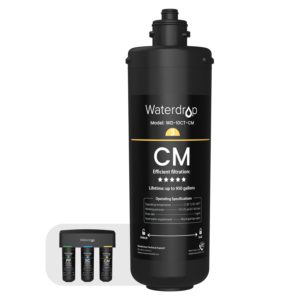
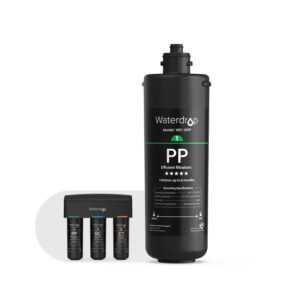
| Ultrafiltration or multi-stage systems | These may address other water-quality requirements, depending on the configuration. | Do not assume a UF membrane or a multi-stage label proves PFAS reduction; verify the exact claim. |
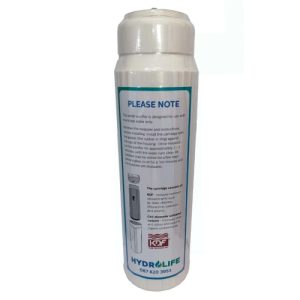
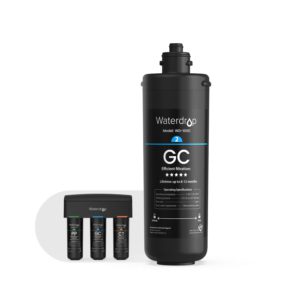
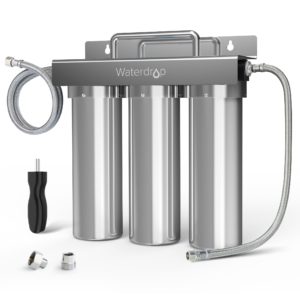
At Hydrolife, we do not believe in forcing every client into one treatment system. We supply countertop and under-sink water-filter options, and our wider service offering includes installation, filter changes, water-treatment support and maintenance. The right starting point is your water source, the concern you want to address, your daily demand and the evidence available for the product being considered. Explore our water-filter options and services to see where we can help.
Questions to ask before buying a PFAS-focused filter
Before choosing a system because of concerns about forever chemicals in tap water, use the following questions to keep the decision evidence-led:
- Has the water supply actually been tested for PFAS, and if so, which compounds were detected?
- Is the filter’s PFAS-reduction claim supported by independent testing for the exact model?
- Which standards, concentrations, flow rates and capacity were used in the test?
- What must be replaced, how often and who will maintain the system?
- Does the system address the full water-quality objective, including any taste, sediment, microbial or scale concerns that matter to your home or workplace?
- Is a point-of-use system sufficient, or is a broader treatment approach genuinely required?
These questions protect against two common mistakes: buying more treatment than you need, or buying a system that is not designed for the problem you are trying to solve. They also make it easier to compare products fairly.
Common mistakes to avoid
The first mistake is treating PFAS as a yes-or-no issue. The family is large, testing panels vary and a result has meaning only in context. The second is assuming that clear-looking or pleasant-tasting water confirms the absence of forever chemicals. It does not.
The third is focusing only on the initial purchase. Filters have a working life. If cartridges, media or membranes are not replaced in line with the manufacturer’s instructions, the system may no longer perform as intended. The fourth is assuming that one technology is automatically best in every situation. Carbon, ion exchange, reverse osmosis and other filtration stages have different roles, trade-offs and evidence bases.
For a broader introduction to household systems, you can also read our guide to water-filter systems for South African homes and our advice on water-filter cartridge replacement.
A practical next step for your home or business
Forever chemicals in tap water are a valid question, but the answer should be based on reliable local information rather than assumptions. PFAS have been found in some South African studies, yet that does not justify a blanket claim about every tap or every water supply. The most useful next step is to establish what is known about your source water, identify the specific treatment goal and verify any product claim against the exact system you plan to use.
At Hydrolife, we can help you work through the practical side of that decision. Contact us to discuss your water source, household or workplace usage, existing equipment and the filtration questions you want answered. We will help you compare suitable options, plan the necessary maintenance and choose a system based on your real requirements rather than a one-size-fits-all promise.